Late Sunday afternoon. You were reading an article earlier which did not have a Facebook share. This article from 'conversation-dot-com' is the original and does. - Amorella
** **
Could consciousness all come down to the way things vibrate?
November 9, 2018 6.45am EST
Why is my awareness here, while yours is over there? Why is the universe split in two for each of us, into a subject and an infinity of objects? How is each of us our own center of experience, receiving information about the rest of the world out there? Why are some things conscious and others apparently not? Is a rat conscious? A gnat? A bacterium?
These questions are all aspects of the ancient “mind-body problem,” which asks, essentially: What is the relationship between mind and matter? It’s resisted a generally satisfying conclusion for thousands of years.
The mind-body problem enjoyed a major rebranding over the last two decades. Now it’s generally known as the “hard problem” of consciousness, after philosopher David Chalmers coined this term in a now classic paper and further explored it in his 1996 book, “The Conscious Mind: In Search of a
Fundamental Theory.”
Chalmers thought the mind-body problem should be called “hard” in comparison to what, with tongue in cheek, he called the “easy” problems of neuroscience: How do neurons and the brain work at the physical level? Of course they’re not actually easy at all. But his point was that they’re relatively easy compared to the truly difficult problem of explaining how consciousness relates to matter.
Over the last decade, my colleague, University of California, Santa Barbara psychology professor Jonathan Schooler and I have developed what we call a “resonance theory of consciousness.” We suggest that resonance – another word for synchronized vibrations – is at the heart of not only human consciousness but also animal consciousness and of physical reality more generally. It sounds like something the hippies might have dreamed up – it’s all vibrations, man! – but stick with me.
All about the vibrations
All things in our universe are constantly in motion, vibrating. Even objects that appear to be stationary are in fact vibrating, oscillating, resonating, at various frequencies. Resonance is a type of motion, characterized by oscillation between two states. And ultimately all matter is just vibrations of various underlying fields. As such, at every scale, all of nature vibrates.
Something interesting happens when different vibrating things come together: They will often start, after a little while, to vibrate together at the same frequency. They “sync up,” sometimes in ways that can seem mysterious. This is described as the phenomenon of spontaneous self-organization.
Mathematician Steven Strogatz provides various examples from physics, biology, chemistry and neuroscience to illustrate “sync” – his term for resonance – in his 2003 book “Sync: How Order Emerges from Chaos in
the Universe, Nature, and Daily Life,” including:
· When fireflies of certain species come together in large gatherings, they start flashing in sync, in ways that can still seem a little mystifying.
· Lasers are produced when photons of the same power and frequency sync up.
· The moon’s rotation is exactly synced with its orbit around the Earth such that we always see the same face.
Examining resonance leads to potentially deep insights about the nature of consciousness and about the universe more generally.
Sync inside your skull
Neuroscientists have identified sync in their research, too. Large-scale neuron firing occurs in human brains at measurable frequencies, with mammalian consciousness thought to be commonly associated with various kinds of neuronal sync.
For example, German neurophysiologist Pascal Fries has explored the ways in which various electrical patterns sync in the brain to produce different types of human consciousness.
Fries focuses on gamma, beta and theta waves. These labels refer to the speed of electrical oscillations in the brain, measured by electrodes placed on the outside of the skull. Groups of neurons produce these oscillations as they use electrochemical impulses to communicate with each other. It’s the speed and voltage of these signals that, when averaged, produce EEG waves that can be measured at signature cycles per second.
Gamma waves are associated with large-scale coordinated activities like perception, meditation or focused consciousness; beta with maximum brain activity or arousal; and theta with relaxation or daydreaming. These three wave types work together to produce, or at least facilitate, various types of human consciousness, according to Fries. But the exact relationship between electrical brain waves and consciousness is still very much up for debate.
Fries calls his concept “communication through coherence.” For him, it’s all about neuronal synchronization. Synchronization, in terms of shared electrical oscillation rates, allows for smooth communication between neurons and groups of neurons. Without this kind of synchronized coherence, inputs arrive at random phases of the neuron excitability cycle and are ineffective, or at least much less effective, in communication.
A resonance theory of consciousness
Our resonance theory builds upon the work of Fries and many others, with a broader approach that can help to explain not only human and mammalian consciousness, but also consciousness more broadly.
Based on the observed behavior of the entities that surround us, from electrons to atoms to molecules, to bacteria to mice, bats, rats, and on, we suggest that all things may be viewed as at least a little conscious. This sounds strange at first blush, but “panpsychism” – the view that all matter has some associated consciousness – is an increasingly accepted positionwith respect to the nature of consciousness.
The panpsychist argues that consciousness did not emerge at some point during evolution. Rather, it’s always associated with matter and vice versa – they’re two sides of the same coin. But the large majority of the mind associated with the various types of matter in our universe is extremely rudimentary. An electron or an atom, for example, enjoys just a tiny amount of consciousness. But as matter becomes more interconnected and rich, so does the mind, and vice versa, according to this way of thinking.
Biological organisms can quickly exchange information through various biophysical pathways, both electrical and electrochemical. Non-biological structures can only exchange information internally using heat/thermal pathways – much slower and far less rich in information in comparison. Living things leverage their speedier information flows into larger-scale consciousness than what would occur in similar-size things like boulders or piles of sand, for example. There’s much greater internal connection and thus far more “going on” in biological structures than in a boulder or a pile of sand.
Under our approach, boulders and piles of sand are “mere aggregates,” just collections of highly rudimentary conscious entities at the atomic or molecular level only. That’s in contrast to what happens in biological life forms where the combinations of these micro-conscious entities together create a higher level macro-conscious entity. For us, this combination process is the hallmark of biological life.
The central thesis of our approach is this: the particular linkages that allow for large-scale consciousness – like those humans and other mammals enjoy – result from a shared resonance among many smaller constituents. The speed of the resonant waves that are present is the limiting factor that determines the size of each conscious entity in each moment.
As a particular[ly] shared resonance expands to more and more constituents, the new conscious entity that results from this resonance and combination grows larger and more complex. So the shared resonance in a human brain that achieves gamma synchrony, for example, includes a far larger number of neurons and neuronal connections than is the case for beta or theta rhythms alone.
What about larger inter-organism resonance like the cloud of fireflies with their little lights flashing in sync? Researchers think their bioluminescent resonance arises due to internal biological oscillators that automatically result in each firefly syncing up with its neighbors.
Is this group of fireflies enjoying a higher level of group consciousness? Probably not, since we can explain the phenomenon without recourse to any intelligence or consciousness. But in biological structures with the right kind of information pathways and processing power, these tendencies toward self-organization can and often do produce larger-scale conscious entities.
Our resonance theory of consciousness attempts to provide a unified framework that includes neuroscience, as well as more fundamental questions of neurobiology and biophysics, and also the philosophy of mind. It gets to the heart of the differences that matter when it comes to consciousness and the evolution of physical systems.
It is all about vibrations, but it’s also about the type of vibrations and, most importantly, about shared vibrations.
Selected and edited from - http://theconversation.com/could-consciousness-all-come-down-to-the-way-things-vibrate-103070
** **
1711 hours. I intuitively feel there is a connection of consciousness shared by 'vibrations'.
** **
vibration | noun - an instance of vibrating: powerful vibrations from an earthquake | the big-capacity engine generated less vibration.
• Physics an oscillation of the parts of a fluid or an elastic solid whose equilibrium has been disturbed, or of an electromagnetic wave.
• (vibrations) informal a person's emotional state, the atmosphere of a place, or the associations of an object as communicated to and felt by others.
Selected and edited from Oxford/American software
** **
The above definition does not define 'vibrations' in the proper context. Drop in synonyms from the Oxford/American. - Amorella
** **
vibration noun- loose bolts are causing the vibration:
tremor, shaking, quivering, quaking, shuddering, throb, throbbing, pulsation; chiefly British judder, juddering.
** **
1729 hours. The synonyms don't work either. The closest words that come to mind, to me, are: 'gravity-like waves' rather than 'vibrations'.
Shall we call them "consciousness waves" in our context? - Amorella
1735 hours. Waves rather than particles sounds good to me mainly because of the subjective intensity of such waves; perhaps even with a loose objective mental connection of consciousness to intuition.
See what's online with reference to intuition and consciousness. - Amorella
** **
Note about the author below: Kieran D. Kelly
Experimental Computer Scientist, and Specialist in Complex Nonlinear Systems and Dynamics.
Founder and Director at Complexity Dynamics, a FinTech Development & Incubation company. Complexity Dynamics develops machine-learning artificial intuition that identify “signatures of behaviour” in complex nonlinear systems.
Chief System Architect at Match Capital, a machine-learning and algorithmic-matching Venture Capital Platform.
Co-Founder of Probability Dynamics Limited a machine-learning and algorithmic-trading Hedge Fund.
Board member of the Complex and Adaptive Systems Laboratory in University College Dublin.
***
What Drives Consciousness and Deep Intuition?
Did “Consciousness” just appear from nowhere, or is there something about the physical universe that means that consciousness is almost guaranteed to emerge?...
PART 1 – CONSCIOUSNESS
Over the last 400 years or so Mathematical Physics has become the science that we rely on to explain the behavior of the universe. Mathematical physics is the ultimate science of deterministic cause and effect. But although physics is good at explaining the obvious dynamics of cause and effect, it turns out that it fails quite miserably when it comes to explaining the not-so-obvious dynamics of “Natural Evolution and Emergent Complexity”…
Compressible Linear Dynamics
In general the science of physics likes to believe that all natural behavior can be explained mathematically, and consequently physicists like to build “mathematical models” of (cause and effect in) the real world. Sometimes these models are unbelievably concise, and can be compressed into a single neat equation, and when this happens we confidently call the model a “Deterministic” “Law of Physics”. However in reality the universe has a range of behavior, from simple to complex, and so unsurprisingly many behaviors are not so easily compressed.
Incompressible Nonlinear Dynamics
The reality is that physics is, in a sense, primarily a science of “linear” dynamics, a science of dynamics “without feedback”. Such dynamics are indeed easily compressible, but our real world is a world that abounds with feedback, a “nonlinear” world full of “incompressible dynamics”.
Nature is the ultimate example of a complex “adaptive” system full of incompressible dynamics. And while there are many systems within Nature which exhibit obvious cause and effect; most of Nature’s behavior is however much more nuanced, and consequently much more difficult to predict.
Complex adaptive systems do not follow strict cause and effect “rules” but instead they have a lot of emergent “associations”. So unlike simple linear dynamics we cannot learn about complex nonlinear dynamics by simply discerning the “mathematical rules”. To truly understand complex nonlinear systems we need a different type of model.
[Note: In the simplest possible terms, linear dynamics are dynamics where the effect is proportional to the cause, and nonlinear dynamics are where the effect can be disproportional to the cause.]
A Different Type of Model
The “Brain” is a “Biological Tool” that has been designed by millions of years of evolution to navigate an external world full of complex nonlinear dynamics.
The Brain mirrors Nature in that it is also a complex adaptive system, and it is constantly adapting its own internal “neural” network to the available data from the external world. This neural network is, in effect, an “abstract model” – effectively, “a map of what is connected to what”…
[Note: In the real world, we use such abstract models all the time. A map of the London Underground is a perfect example.
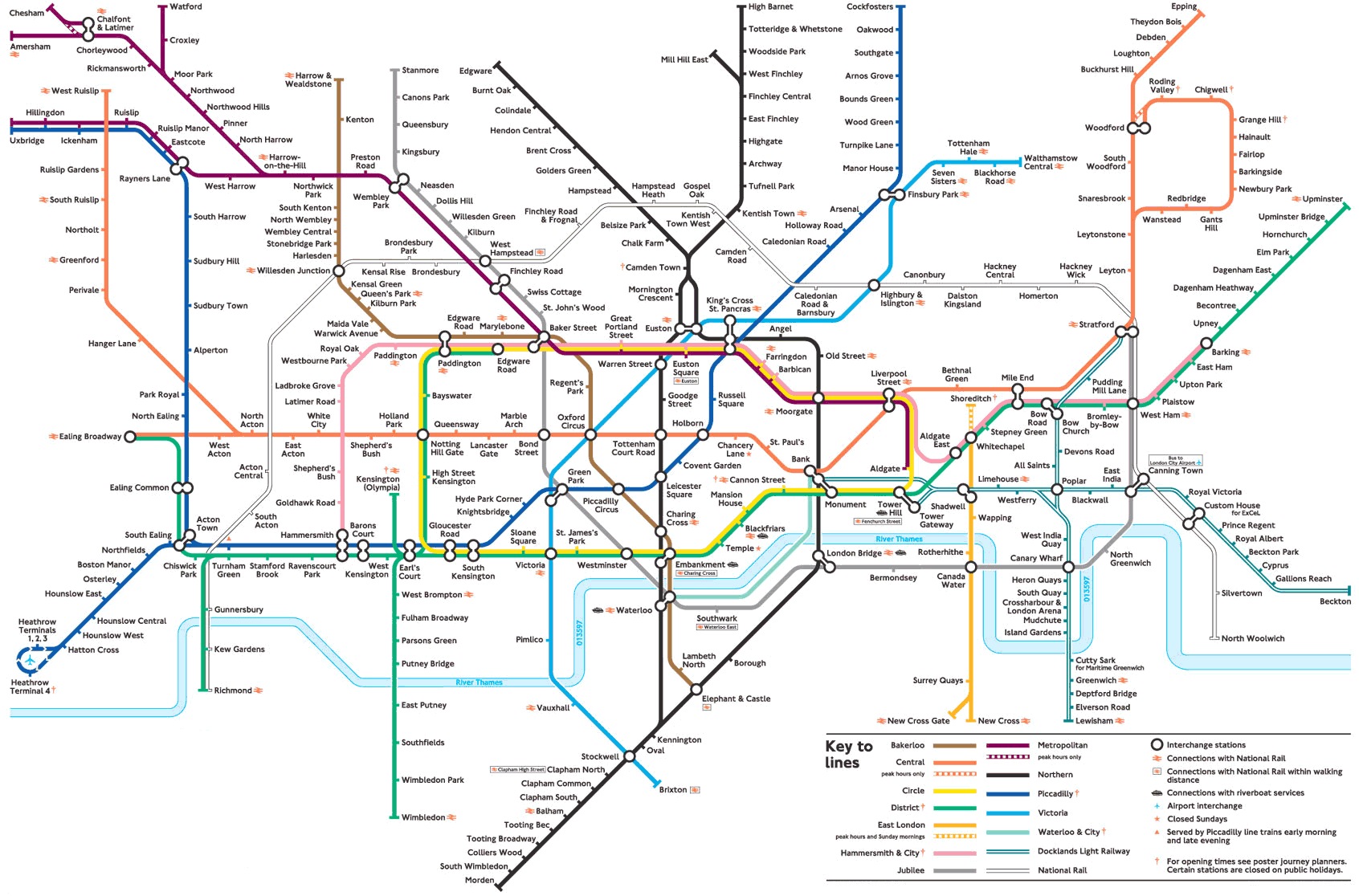
This nonlinear map is obviously not an exact representation of locations in physical space, but it is nonetheless a good enough model, to give us a working understanding of the fundamental structure of the underground network.]
So the “Brain” is basically a complex connectivity map, and the “Emergent Mind” simply a reflection of how the brain is wired up.
“Consciousness” bubbles up from this emergent mind. And at its most fundamental, “Emergent Consciousness” is nothing more than the “surface representation” of a subconscious “Library of Instincts” and “Laboratory of Intuitions”…
PART 2 – DEEP INTUITION
So emergent consciousness is simply the “surfacing” of a biological process of “abstract modeling and pattern recognition”. But over many millions of years however, “The Conscious Mind” has developed way beyond mere pattern recognition. This development is most obvious in modern humans. Over long periods of time Mankind slowly turned recognizable patterns of cause and effect into technology and engineering by a gradual process of trial and error. And in the last 400 years or so, human consciousness took things a step further by actually teasing out the underlying mathematics that governs the linear dynamics of cause and effect. But despite all this incredible evolution of conscious and rational linear thinking, we can still struggle badly when it comes to dealing with “the dynamics of feedback and nonlinear complexity”…
Fast Nonlinear Thinking
The Brain has been designed to deal with a nonlinear world, and complex nonlinear pattern recognition is actually it speciality. The subconscious mind is a library of instincts, and a laboratory of intuitions. Essentially we can think of instincts as simply hard-corded intuitions, but intuitions themselves are better thought of as soft-coded works in progress…
Some time ago Daniel Kahneman wrote a book called “Thinking, Fast and Slow” in which he basically suggested that we cannot rely on our fast thinking intuition; that generally speaking while our intuition works well when dealing with simplicity, it tend to lets us down when dealing with even the smallest amount of complexity.
This however need not always be the case. The reality is that, in an ever more complex interconnected world, our fast “nonlinear” thinking can be a much more valuable, and “insightful”, tool than our slow “linear” thinking – but in order for this to be so, we do need to train it correctly…
Integration for Free
In his book “Bounce” Matthew Syed argues that “Talent” is not God-given, but must be worked at — the ultimate result of many long hours of practice. Virtually anyone who is any good at anything will recognize the truth in these words. But how exactly does practice make perfect?…
Think about what is involved in learning to play tennis to very high level. Bad tennis players essentially play every shot more or less the same way; the forehand is almost the same shot as the backhand, even the serve is essentially just racket meets ball. People who play tennis well however, have learned to separate, or differentiate, one stroke from another; they have fine-tuned the mechanics of each individual stroke from hours and hours of practice and “evaluated feedback”.
Strangely enough though, despite this constant focus on training the mechanics of each unique stroke, nobody ever seems to train the transition from one stroke to another — that somehow just seems to come naturally over time. It seems that the co-training of a diversity of different strokes means that the integration comes for free…
In truth however while “practice focused on feedback” may consolidate the technique of each individual stroke, it is only through “competitive practice” that these finely-tuned strokes are ultimately combined into a single integrated style of play. It is this competitive practice, this necessary “integration” (of a repertoire of differently trained strokes) that ultimately makes “the whole greater than the sum of its parts”…
Differentiate + Integrate
Learning to play tennis (or anything else for that matter) is simply a process of work and play, of training and application, of differentiation and integration, repeated over and over again. In a similar vein, “Intuition” can be thought of as a nonlinear map, built from the bottom-up by the constant interplay of conscious differentiation and subconscious integration.
[Note: In general, as humans, we learn to model the world by trial and error (although trial and evaluation of feedback is probably a more accurate, if clumsier, representation). The brain makes sense of the world, the same way a child makes sense of a jigsaw puzzle. A child will separate out all the edge pieces, separate out all the sky pieces, separate out all the castle pieces etc, etc, and then try to fit them all together.]
The brain carries out the conscious process of differentiation when awake and deeply focused and the subconscious process of integration when asleep and deeply relaxed. During sleep the subconscious mind is effectively trying its best to compress and integrate the diversity of information it has learnt into a single “Coherent Whole”.
[Note: The information can only be compressed to its maximum compression but no more — this is the basic idea behind something called “information entropy”].
Language is probably the most obvious example of the nonlinear emergence of integrated feedback. A child does not learn to speak by learning the linear rules; it is only with much practice, attention to feedback, and deep sleep, that nonlinear language ultimately bubbles up to the surface…
This nonlinear learning, this subconscious integration, bubbling up to the surface is the same process that drives our “Intuitive Pattern Recognition”. And so if the premise of Matthew Syed’s argument (that only “evaluated” practice makes perfect) can be extended to the nonlinear mind, then any lack of “deep pattern recognition” is simply a lack of subconscious integration, which itself results from a lack of both conscious differentiation and conscious awareness of feedback…
Integration + Inspiration
It is often said about great discoveries that, “chance favors the prepared mind”, and so it is with deep pattern recognition.
Through the subconscious integration of a diversity of information a fully formed coherent idea can suddenly emerge into consciousness as if by a random thought. But this is not really a random thought. This “information structure” has probably been forming in the subconscious mind for a very long time indeed — before ultimately surfacing into consciousness in what appears to be a moment of “eureka” inspiration.
So although such spontaneous insights (about “how things fit together” ) can seem as if it they come out of nowhere; they are in fact simply the result of the nonlinear integration of a diversity of information which ultimately surface in moments of “Deep Intuition”.
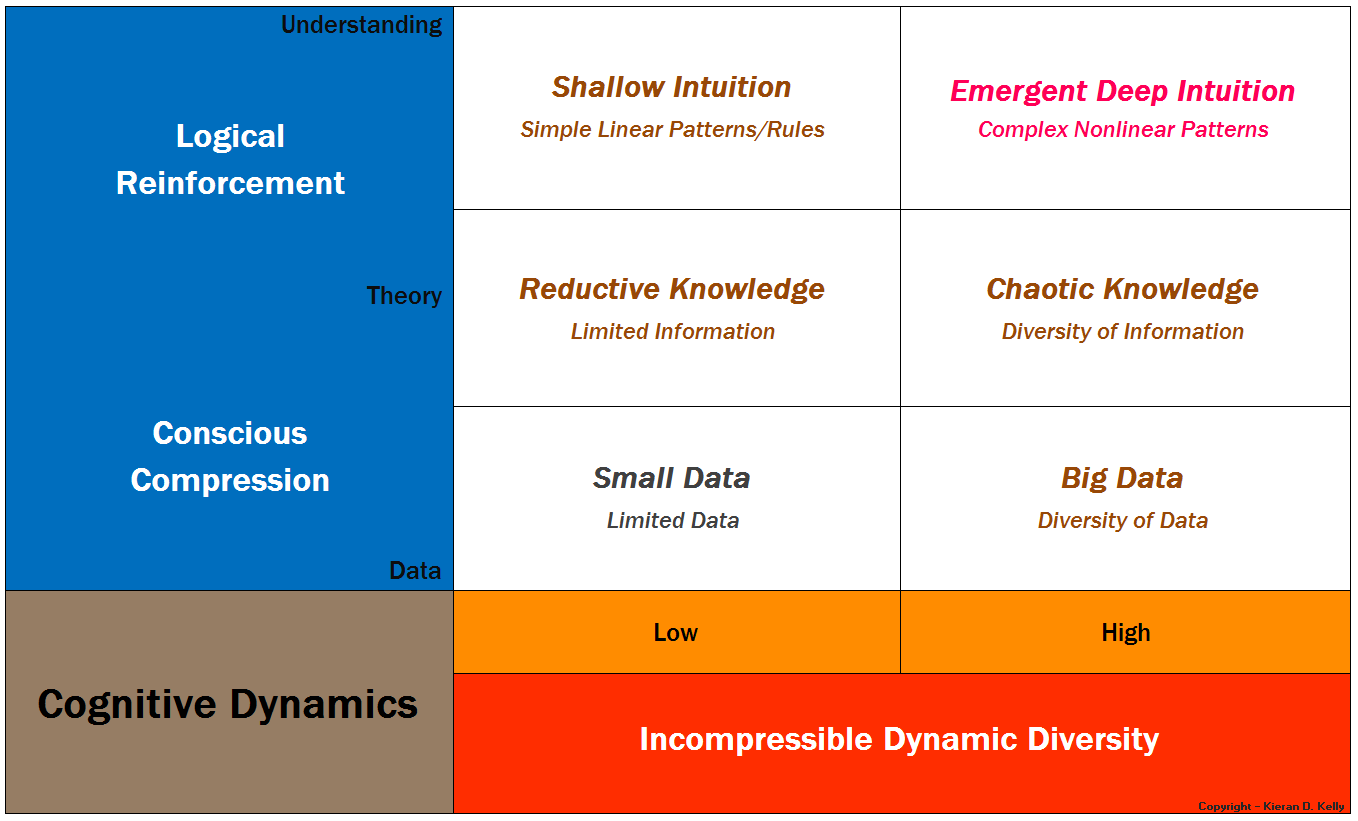
Below is a graphical representation of the interplay of diversity and selection (by compression + reinforcement)
CONCLUSION
Both “Consciousness” and “Deep Intuition” are obviously merely different levels of cognition and “Awareness”, but what differentiates them is what drives them…
“What Drives Consciousness is the Subconscious Compression and Reinforcement of Data”.
But what drives deep intuition is slightly more nuanced.
“What Drives Deep Intuition is the Subconscious Integration of Chaotic Diversity of Information”.
And consequently just as the integrated game is a free by-product of the co-training of a diversity of different tennis strokes, so too when we co-train our conscious linear minds on a wide diversity of data,
Our Subconscious Nonlinear Minds will often provide
“Deep Intuition for Free!”…
Selected and edited from - http://www.kierandkelly.com/what-drives-consciousness/
[Facebook sharable from the source}
** **
1757 hours. I feel more directed with these concepts after reading the above. The focus is reinforced by the conclusion of the article.
** **
Both “Consciousness” and “Deep Intuition” are obviously merely different levels of cognition and “Awareness”, but what differentiates them is what drives them…
“What Drives Consciousness is the Subconscious Compression and Reinforcement of Data”.
But what drives deep intuition is slightly more nuanced.
“What Drives Deep Intuition is the Subconscious Integration of Chaotic Diversity of Information”.
And consequently just as the integrated game is a free by-product of the co-training of a diversity of different tennis strokes, so too when we co-train our conscious linear minds on a wide diversity of data,
Our Subconscious Nonlinear Minds will often provide
“Deep Intuition for Free!” ...
** **
From the beginning the subconscious and unconscious has been myline to your heartansoulanmind, boy. It began in the 1980's when Dr. Payne at the University of Cincinnati showed you the 'string and washer' as a possible entry to your subconscious to help you control your weight after your first session with hypnosis. - Amorella
1808 hours. True. And, for me the subconscious led me to the unconscious.
I led you to the unconscious mind, young man. - Amorella
1811 hours. I agree. This can readily be observed in my Encounters in Mind blog.
Post. - Amorella

No comments:
Post a Comment
I expect a thoughtful and honest message formed in a polite manner.