Sunday, December 9, 2018

21. Notes - on the plausibility of 'consciousness waves'


Late Sunday afternoon. You were reading an article earlier which did not have a Facebook share. This article from 'conversation-dot-com' is the original and does. - Amorella

** **

Could consciousness all come down to the way things vibrate?

November 9, 2018 6.45am EST


Why is my awareness here, while yours is over there? Why is the universe split in two for each of us, into a subject and an infinity of objects? How is each of us our own center of experience, receiving information about the rest of the world out there? Why are some things conscious and others apparently not? Is a rat conscious? A gnat? A bacterium? 
These questions are all aspects of the ancient “mind-body problem,” which asks, essentially: What is the relationship between mind and matter? It’s resisted a generally satisfying conclusion for thousands of years. 
The mind-body problem enjoyed a major rebranding over the last two decades. Now it’s generally known as the “hard problem” of consciousness, after philosopher David Chalmers coined this term in a now classic paper and further explored it in his 1996 book, “The Conscious Mind: In Search of a Fundamental Theory.”
Chalmers thought the mind-body problem should be called “hard” in comparison to what, with tongue in cheek, he called the “easy” problems of neuroscience: How do neurons and the brain work at the physical level? Of course they’re not actually easy at all. But his point was that they’re relatively easy compared to the truly difficult problem of explaining how consciousness relates to matter.
Over the last decade, my colleague, University of California, Santa Barbara psychology professor Jonathan Schooler and I have developed what we call a “resonance theory of consciousness.” We suggest that resonance – another word for synchronized vibrations – is at the heart of not only human consciousness but also animal consciousness and of physical reality more generally. It sounds like something the hippies might have dreamed up – it’s all vibrations, man! – but stick with me.

All about the vibrations

All things in our universe are constantly in motion, vibrating. Even objects that appear to be stationary are in fact vibrating, oscillating, resonating, at various frequencies. Resonance is a type of motion, characterized by oscillation between two states. And ultimately all matter is just vibrations of various underlying fields. As such, at every scale, all of nature vibrates. 
Something interesting happens when different vibrating things come together: They will often start, after a little while, to vibrate together at the same frequency. They “sync up,” sometimes in ways that can seem mysterious. This is described as the phenomenon of spontaneous self-organization. 
Mathematician Steven Strogatz provides various examples from physics, biology, chemistry and neuroscience to illustrate “sync” – his term for resonance – in his 2003 book “Sync: How Order Emerges from Chaos in the Universe, Nature, and Daily Life,” including:
·      When fireflies of certain species come together in large gatherings, they start flashing in sync, in ways that can still seem a little mystifying.
·      Lasers are produced when photons of the same power and frequency sync up.
·      The moon’s rotation is exactly synced with its orbit around the Earth such that we always see the same face.
Examining resonance leads to potentially deep insights about the nature of consciousness and about the universe more generally.
Sync inside your skull
Neuroscientists have identified sync in their research, too. Large-scale neuron firing occurs in human brains at measurable frequencies, with mammalian consciousness thought to be commonly associated with various kinds of neuronal sync.
For example, German neurophysiologist Pascal Fries has explored the ways in which various electrical patterns sync in the brain to produce different types of human consciousness. 
Fries focuses on gamma, beta and theta waves. These labels refer to the speed of electrical oscillations in the brain, measured by electrodes placed on the outside of the skull. Groups of neurons produce these oscillations as they use electrochemical impulses to communicate with each other. It’s the speed and voltage of these signals that, when averaged, produce EEG waves that can be measured at signature cycles per second.
Gamma waves are associated with large-scale coordinated activities like perception, meditation or focused consciousness; beta with maximum brain activity or arousal; and theta with relaxation or daydreaming. These three wave types work together to produce, or at least facilitate, various types of human consciousness, according to Fries. But the exact relationship between electrical brain waves and consciousness is still very much up for debate.
Fries calls his concept “communication through coherence.” For him, it’s all about neuronal synchronization. Synchronization, in terms of shared electrical oscillation rates, allows for smooth communication between neurons and groups of neurons. Without this kind of synchronized coherence, inputs arrive at random phases of the neuron excitability cycle and are ineffective, or at least much less effective, in communication. 

A resonance theory of consciousness

Our resonance theory builds upon the work of Fries and many others, with a broader approach that can help to explain not only human and mammalian consciousness, but also consciousness more broadly.
Based on the observed behavior of the entities that surround us, from electrons to atoms to molecules, to bacteria to mice, bats, rats, and on, we suggest that all things may be viewed as at least a little conscious. This sounds strange at first blush, but “panpsychism” – the view that all matter has some associated consciousness – is an increasingly accepted positionwith respect to the nature of consciousness. 
The panpsychist argues that consciousness did not emerge at some point during evolution. Rather, it’s always associated with matter and vice versa – they’re two sides of the same coin. But the large majority of the mind associated with the various types of matter in our universe is extremely rudimentary. An electron or an atom, for example, enjoys just a tiny amount of consciousness. But as matter becomes more interconnected and rich, so does the mind, and vice versa, according to this way of thinking.
Biological organisms can quickly exchange information through various biophysical pathways, both electrical and electrochemical. Non-biological structures can only exchange information internally using heat/thermal pathways – much slower and far less rich in information in comparison. Living things leverage their speedier information flows into larger-scale consciousness than what would occur in similar-size things like boulders or piles of sand, for example. There’s much greater internal connection and thus far more “going on” in biological structures than in a boulder or a pile of sand.
Under our approach, boulders and piles of sand are “mere aggregates,” just collections of highly rudimentary conscious entities at the atomic or molecular level only. That’s in contrast to what happens in biological life forms where the combinations of these micro-conscious entities together create a higher level macro-conscious entity. For us, this combination process is the hallmark of biological life. 
The central thesis of our approach is this: the particular linkages that allow for large-scale consciousness – like those humans and other mammals enjoy – result from a shared resonance among many smaller constituents. The speed of the resonant waves that are present is the limiting factor that determines the size of each conscious entity in each moment. 
As a particular[ly] shared resonance expands to more and more constituents, the new conscious entity that results from this resonance and combination grows larger and more complex. So the shared resonance in a human brain that achieves gamma synchrony, for example, includes a far larger number of neurons and neuronal connections than is the case for beta or theta rhythms alone.
What about larger inter-organism resonance like the cloud of fireflies with their little lights flashing in sync? Researchers think their bioluminescent resonance arises due to internal biological oscillators that automatically result in each firefly syncing up with its neighbors.
Is this group of fireflies enjoying a higher level of group consciousness? Probably not, since we can explain the phenomenon without recourse to any intelligence or consciousness. But in biological structures with the right kind of information pathways and processing power, these tendencies toward self-organization can and often do produce larger-scale conscious entities. 
Our resonance theory of consciousness attempts to provide a unified framework that includes neuroscience, as well as more fundamental questions of neurobiology and biophysics, and also the philosophy of mind. It gets to the heart of the differences that matter when it comes to consciousness and the evolution of physical systems. 
It is all about vibrations, but it’s also about the type of vibrations and, most importantly, about shared vibrations.
Selected and edited from - http://theconversation.com/could-consciousness-all-come-down-to-the-way-things-vibrate-103070

** **

       1711 hours. I intuitively feel there is a connection of consciousness shared by 'vibrations'. 

** **
vibration | noun -  an instance of vibrating: powerful vibrations from an earthquake | the big-capacity engine generated less vibration. 

 Physics an oscillation of the parts of a fluid or an elastic solid whose equilibrium has been disturbed, or of an electromagnetic wave. 

 (vibrations) informal a person's emotional state, the atmosphere of a place, or the associations of an object as communicated to and felt by others.

Selected and edited from Oxford/American software

** **
       The above definition does not define 'vibrations' in the proper context. Drop in synonyms from the Oxford/American. - Amorella

** **
vibration nounloose bolts are causing the vibration: 

tremor, shaking, quivering, quaking, shuddering, throb, throbbing, pulsation; chiefly British judder, juddering.

** **

       1729 hours. The synonyms don't work either. The closest words that come to mind, to me, are: 'gravity-like waves' rather than 'vibrations'. 

       Shall we call them "consciousness waves" in our context? - Amorella

       1735 hours. Waves rather than particles sounds good to me mainly because of the subjective intensity of such waves; perhaps even with a loose objective mental connection of consciousness to intuition.

       See what's online with reference to intuition and consciousness. - Amorella

** **

Note about the author below: Kieran D. Kelly

Experimental Computer Scientist, and Specialist in Complex Nonlinear Systems and Dynamics.
KDK 001
Founder and Director at Complexity Dynamics, a FinTech Development & Incubation company. Complexity Dynamics develops machine-learning artificial intuition that identify “signatures of behaviour” in complex nonlinear systems.
Chief System Architect at Match Capital, a machine-learning and algorithmic-matching Venture Capital Platform.
Co-Founder of Probability Dynamics Limited a machine-learning and algorithmic-trading Hedge Fund.
Board member of the Complex and Adaptive Systems Laboratory in University College Dublin.
***  

What Drives Consciousness and Deep Intuition?


Did “Consciousness” just appear from nowhere, or is there something about the physical universe that means that consciousness is almost guaranteed to emerge?...


PART 1 – CONSCIOUSNESS


Over the last 400 years or so Mathematical Physics has become the science that we rely on to explain the behavior of the universe.  Mathematical physics is the ultimate science of deterministic cause and effect.  But although physics is good at explaining the obvious dynamics of  cause and effect, it turns out that it fails quite miserably when it comes to explaining the not-so-obvious dynamics of “Natural Evolution and Emergent Complexity”
Compressible Linear Dynamics
In general the science of physics likes to believe that all natural behavior can be explained mathematically, and consequently physicists like to build “mathematical models” of (cause and effect in) the real world.  Sometimes these models are unbelievably concise, and can be compressed into a single neat equation, and when this happens we confidently call the model a “Deterministic” “Law of Physics”.  However in reality the universe has a range of behavior, from simple to complex, and so unsurprisingly many behaviors are not so easily compressed.
Incompressible Nonlinear Dynamics
The reality is that physics is, in a sense, primarily a science of “linear” dynamics, a science of dynamics “without feedback”.  Such dynamics are indeed easily compressible, but our real world is a world that abounds with feedback, a “nonlinear” world full of “incompressible dynamics”.
Nature is the ultimate example of a complex “adaptive” system full of incompressible dynamics.  And while there are many systems within Nature which exhibit obvious cause and effect; most of Nature’s behavior is however much more nuanced, and consequently much more difficult to predict.
Complex adaptive systems do not follow strict cause and effect “rules” but instead they have a lot of emergent “associations”.  So unlike simple linear dynamics we cannot learn about complex nonlinear dynamics by simply discerning the “mathematical rules”.  To truly understand complex nonlinear systems we need a different type of model.
[Note: In the simplest possible terms, linear dynamics are dynamics where the effect is proportional to the cause, and nonlinear dynamics are where the effect can be disproportional to the cause.]
A Different Type of Model
The “Brain” is a “Biological Tool” that has been designed by millions of years of evolution to navigate an external world full of complex nonlinear dynamics.
The Brain mirrors Nature in that it is also a complex adaptive system, and it is constantly adapting its own internal “neural” network to the available data from the external world.  This neural network is, in effect, an “abstract model” – effectively, “a map of what is connected to what”…
[Note: In the real world, we use such abstract models all the time.  A map of the London Underground is a perfect example.  
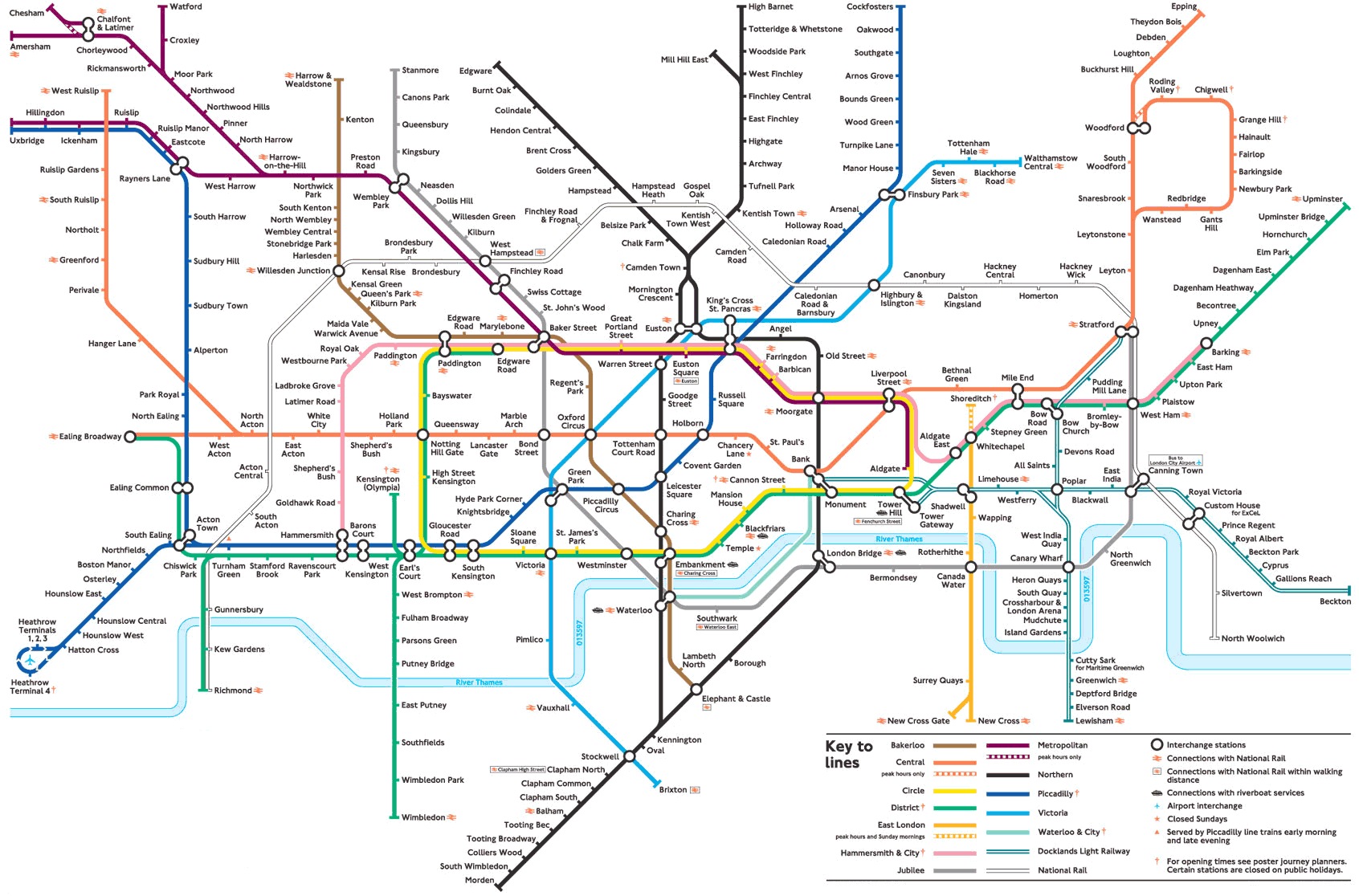
Model/Map of the London Underground Transport System
This nonlinear map is obviously not an exact representation of locations in physical space, but it is nonetheless a good enough model, to give us a working understanding of the fundamental structure of the underground network.]
So the “Brain” is basically a complex connectivity map, and the “Emergent Mind” simply a reflection of how the brain is wired up.
“Consciousness” bubbles up from this emergent mind.  And at its most fundamental, “Emergent Consciousness” is nothing more than the surface representation of a subconscious “Library of Instincts” and “Laboratory of Intuitions”…
  

PART 2 – DEEP INTUITION


So emergent consciousness is simply the “surfacing” of a biological process of “abstract modeling and pattern recognition”.  But over many millions of years however, “The Conscious Mind” has developed way beyond mere pattern recognition.  This development is most obvious in modern humans.  Over long periods of time Mankind slowly turned recognizable patterns of cause and effect into technology and engineering by a gradual process of trial and error.  And in the last 400 years or so, human consciousness took things a step further by actually teasing out the underlying mathematics that governs the linear dynamics of cause and effect.  But despite all this incredible evolution of conscious and rational linear thinking, we can still struggle badly when it comes to dealing with “the dynamics of feedback and nonlinear complexity”…
Fast Nonlinear Thinking
The Brain has been designed to deal with a nonlinear world, and complex nonlinear pattern recognition is actually it speciality.  The subconscious mind is a library of instincts, and a laboratory of intuitions.  Essentially we can think of instincts as simply hard-corded intuitions, but intuitions themselves are better thought of as soft-coded works in progress…
Some time ago Daniel Kahneman wrote a book called “Thinking, Fast and Slow” in which he basically suggested that we cannot rely on our fast thinking intuition; that generally speaking while our intuition works well when dealing with simplicity, it tend to lets us down when dealing with even the smallest amount of complexity.
This however need not always be the case.  The reality is that, in an ever more complex interconnected world, our fast “nonlinear” thinking can be a much more valuable, and “insightful”, tool than our slow “linear” thinking – but in order for this to be so, we do need to train it correctly…
Integration for Free
In his book “Bounce” Matthew Syed argues that “Talent” is not God-given, but must be worked at — the ultimate result of many long hours of practice.  Virtually anyone who is any good at anything will recognize the truth in these words.  But how exactly does practice make perfect?…
Think about what is involved in learning to play tennis to very high level.  Bad tennis players essentially play every shot more or less the same way; the forehand is almost the same shot as the backhand, even the serve is essentially just racket meets ball.   People who play tennis well however, have learned to separate, or differentiate, one stroke from another; they have fine-tuned the mechanics of each individual stroke from hours and hours of practice and “evaluated feedback”.
Strangely enough though, despite this constant focus on training the mechanics of each unique stroke, nobody ever seems to train the transition from one stroke to another — that somehow just seems to come naturally over time.  It seems that the co-training of a diversity of different strokes means that the integration comes for free…
In truth however while “practice focused on feedback” may consolidate the technique of each individual stroke, it is only through “competitive practice” that these finely-tuned strokes are ultimately combined into a single integrated style of play.  It is this competitive practice, this necessary “integration” (of a repertoire of differently trained strokes) that ultimately makes “the whole greater than the sum of its parts”
Differentiate + Integrate
Learning to play tennis (or anything else for that matter) is simply a process of work and play, of training and application, of differentiation and integration, repeated over and over again.  In a similar vein, “Intuition” can be thought of as a nonlinear map, built from the bottom-up by the constant interplay of conscious differentiation and subconscious integration.
[Note:   In general, as humans, we learn to model the world by trial and error (although trial and evaluation of feedback is probably a more accurate, if clumsier, representation).  The brain makes sense of the world, the same way a child makes sense of a jigsaw puzzle.   A child will separate out all the edge pieces, separate out all the sky pieces, separate out all the castle pieces etc, etc, and then try to fit them all together.]
The brain carries out the conscious process of differentiation when awake and deeply focused and the subconscious process of integration when asleep and deeply relaxed.  During sleep the subconscious mind is effectively trying its best to compress and integrate the diversity of information it has learnt into a single “Coherent Whole”.
[Note:  The information can only be compressed to its maximum compression but no more — this is the basic idea behind something called “information entropy”].
Language is probably the most obvious example of the nonlinear emergence of integrated feedback.  A child does not learn to speak by learning the linear rules; it is only with much practice, attention to feedback, and deep sleep, that nonlinear language ultimately bubbles up to the surface…
This nonlinear learning, this subconscious integration, bubbling up to the surface is the same process that drives our “Intuitive Pattern Recognition”.  And so if the premise of Matthew Syed’s argument (that only “evaluated” practice makes perfect) can be extended to the nonlinear mind, then any lack of “deep pattern recognition” is simply a lack of subconscious integration, which itself results from a lack of both conscious differentiation and conscious awareness of feedback…
Integration + Inspiration
It is often said about great discoveries that, “chance favors the prepared mind”, and so it is with deep pattern recognition.
Through the subconscious integration of a diversity of information a fully formed coherent idea can suddenly emerge into consciousness as if by a random thought.  But this is not really a random thought.  This “information structure” has probably been forming in the subconscious mind for a very long time indeed — before ultimately surfacing into consciousness in what appears to be a moment of “eureka” inspiration.
So although such spontaneous insights (about “how things fit together” ) can seem as if it they come out of nowhere; they are in fact simply the result of the nonlinear integration of a diversity of information which ultimately surface in moments of “Deep Intuition”.
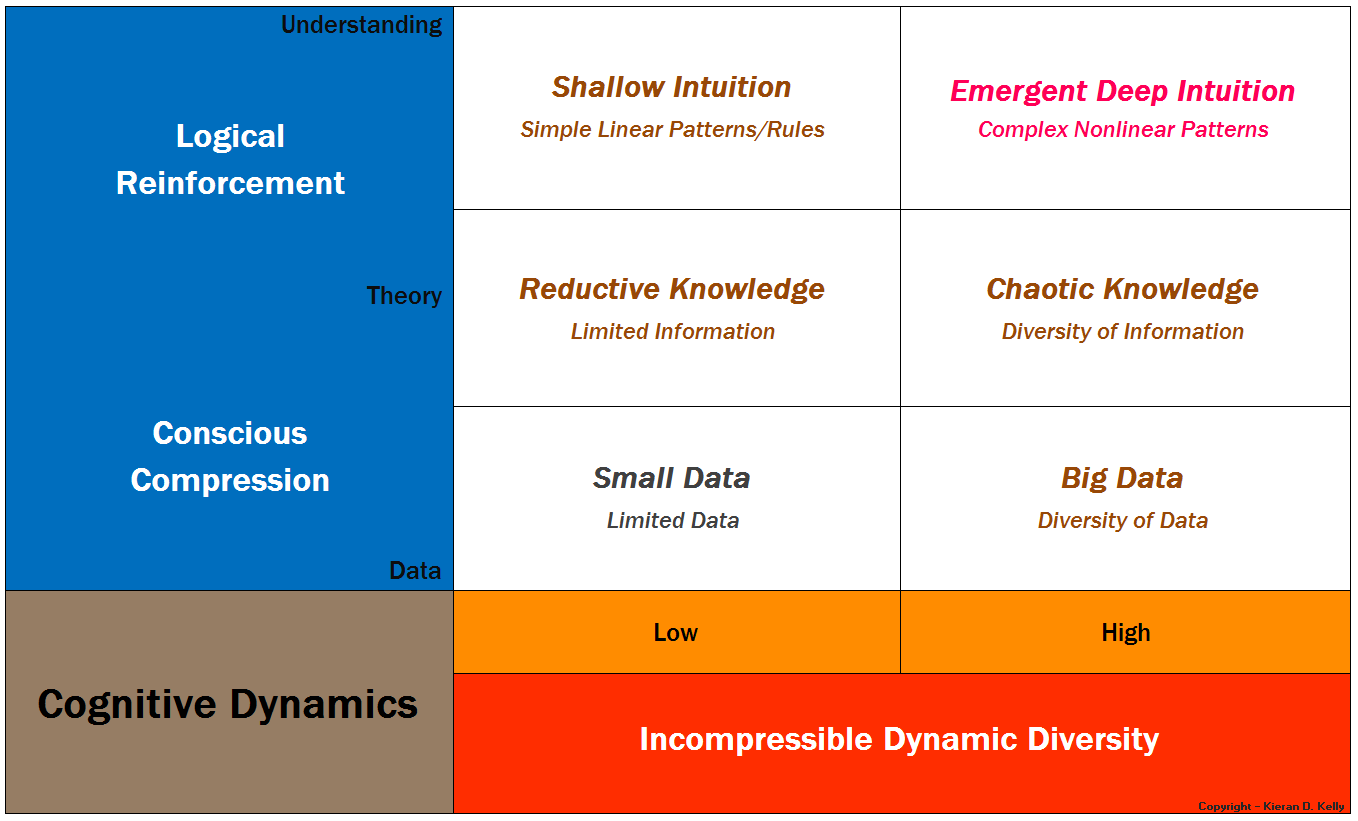
Below is a graphical representation of the interplay of diversity and selection (by compression + reinforcement)Matrix of Cognitive Dynamics

CONCLUSION

Both “Consciousness” and “Deep Intuition” are obviously merely different levels of cognition and “Awareness”, but what differentiates them is what drives them…
“What Drives Consciousness is the Subconscious Compression and Reinforcement of Data”.
But what drives deep intuition is slightly more nuanced.
“What Drives Deep Intuition is the Subconscious Integration of Chaotic Diversity of Information”.
And consequently just as the integrated game is a free by-product of the co-training of a diversity of different tennis strokes, so too when we co-train our conscious linear minds on a wide diversity of data,
Our Subconscious Nonlinear Minds will often provide
Deep Intuition for Free!”…
Selected and edited from - http://www.kierandkelly.com/what-drives-consciousness/

[Facebook sharable from the source}

** **

       1757 hours. I feel more directed with these concepts after reading the above. The focus is reinforced by the conclusion of the article. 

** **
Both “Consciousness” and “Deep Intuition” are obviously merely different levels of cognition and “Awareness”, but what differentiates them is what drives them…
“What Drives Consciousness is the Subconscious Compression and Reinforcement of Data”.
But what drives deep intuition is slightly more nuanced.
“What Drives Deep Intuition is the Subconscious Integration of Chaotic Diversity of Information”.
And consequently just as the integrated game is a free by-product of the co-training of a diversity of different tennis strokes, so too when we co-train our conscious linear minds on a wide diversity of data,
Our Subconscious Nonlinear Minds will often provide
Deep Intuition for Free!” ...

** **

       From the beginning the subconscious and unconscious has been myline to your heartansoulanmind, boy. It began in the 1980's when Dr. Payne at the University of Cincinnati showed you the 'string and washer' as a possible entry to your subconscious to help you control your weight after your first session with hypnosis. - Amorella

       1808 hours. True. And, for me the subconscious led me to the unconscious.

       I led you to the unconscious mind, young man. - Amorella

       1811 hours. I agree. This can readily be observed in my Encounters in Mind blog. 


       Post. - Amorella

Saturday, December 8, 2018

20. Notes - point taken


8 December 2018

       2124 hours. Yesternight you concluded with, "You [myself] are the nature of your culture, your education and your own human mind." What of my soul? I do not consider my soul human as a separate entity. Amorella, what is the soul's nature within myself?

       Your soul is a constant, boy. Even while you are physically alive it openly holds the heart and mind. - Amorella

       2132 hours. This implies a touch or an encounter.

       An 'encounter' works absolutely. - Amorella

       2134 hours. I need a definition here. Words are tricky with meanings in context, especially metaphysical-like context. 

** **
encounter | 

verb [with object] unexpectedly experience or be faced with (something difficult or hostile): we have encountered one small problem• meet (someone) unexpectedly. 

noun an unexpected or casual meeting with someone or something. • a confrontation or unpleasant struggle: his close encounter with death

ORIGIN Middle English (in the senses ‘meet as an adversary’ and ‘a meeting of adversaries’; formerly also as incounter): from Old French encontrer (verb), encontre (noun), based on Latin in- ‘in’ + contra ‘against’.

Selected and edited from my English/American software

** **
       
       You set the tone but it is not in context. This is a better definition in context. The soul is an unexpected experience for heart and mind, that is, it is difficult to comprehend as it appears alien-like. It must be faced by heart and mind, that is, it is a one on one meeting rarely a combined meeting of heartanmind together. The meeting of soul with either heart or mind or both is always unexpected. The soul's nature, as it were, demands a sense of confrontation, usually unpleasant because the meeting appears unexpected to the human heart and mind. Truth be told, meeting one's soul might be construed to meeting, as it were, G-D undressed. - Amorella
       
       2153 hours. Your words leave me without imagination.

       That is the point. Post. - Amorella

Friday, December 7, 2018

19. Notes - silence: sacred in time and place


       Friday evening. Last night you first used your new Bose Quiet Comfort 35 II headphones. - Amorella

       2124  hours. The noise cancelling is first rate and even without any music or noise cancelling on it keeps me in a spiritually quiet mode. I might as well be deep in a northern forest or on a high topping mountain. Very little to no audio distraction even with I-71 just over the hill. I am  positively quite amazed with the Bose noise  cancelling technology. The sound system is solid and Google Assistant is built into the headphones. With what I have experienced to date, I would have paid full price, but I am happy that Paul found me a deal on Black Friday. The spiritual aspect of silence is the most important feature the headphones provide. They allow me the quietness of a sacred site. 

       Let's check Wikipedia for a definition. - Amorella

       2214 hours. I did not find a suitable personal definition, but I can recommend Mircea Eliade's The Sacred and the Profane. The article below is heavily edited to focus on what I consider to be the importance of his work on what is sacred and what is profane. Another author who has been important in my spiritual development are a variety of works by Joseph Campbell. Both are centers of background once used in my lectures in "Mythology" at Indian Hill High School.

** **

Mircea Eliade

From Wikipedia, the free encyclopedia


Mircea Eliade (Romanian:March 9 [O.S. February 24] 1907 – April 22, 1986) was a Romanian historian of religion, fiction writer, philosopher, and professor at the University of Chicago. He was a leading interpreter of religious experience, who established paradigms in religious studies that persist to this day. His theory that hierophanies form the basis of religion, splitting the human experience of reality into sacred and profane space and time, has proved influential.[1]One of his most influential contributions to religious studies was his theory of Eternal Return, which holds that myths and rituals do not simply commemorate hierophanies, but, at least to the minds of the religious, that the hierophanies actually participate in them.[1]


The general nature of religion

In his work on the history of religion, Eliade is most highly regarded for his writings on Alchemy,[80] Shamanism, Yoga and what he called the eternal return—the implicit belief, supposedly present in religious thought in general, that religious behavior is not only an imitation of, but also a participation in, sacred events, and thus restores the mythical time of origins. Eliade's thinking was in part influenced by Rudolf Otto, Gerardus van der Leeuw, Nae Ionescu and the writings of the Traditionalist School (René Guénon and Julius Evola).[37] For instance, Eliade's The Sacred and the Profane partially builds on Otto's The Idea of the Holy to show how religion emerges from the experience of the sacred, and myths of time and nature.
Eliade is known for his attempt to find broad, cross-cultural parallels and unities in religion, particularly in myths. Wendy Doniger, Eliade's colleague from 1978 until his death, has observed that "Eliade argued boldly for universals where he might more safely have argued for widely prevalent patterns".[81] His Treatise on the History of Religions was praised by French philologist Georges Dumézil for its coherence and ability to synthesize diverse and distinct mythologies.[82]
Robert Ellwood describes Eliade's approach to religion as follows. Eliade approaches religion by imagining an ideally "religious" person, whom he calls homo religiosus in his writings. Eliade's theories basically describe how this homo religiosus would view the world.[83] This does not mean that all religious practitioners actually think and act like homo religiosus. Instead, it means that religious behavior "says through its own language" that the world is as homo religiosus would see it, whether or not the real-life participants in religious behavior are aware of it.[84] However, Ellwood writes that Eliade "tends to slide over that last qualification", implying that traditional societies actually thought like homo religiosus.[84]

Sacred and profane


Eliade argues that "Yahweh is both kind and wrathful; the God of the Christian mystics and theologians is terrible and gentle at once".[85] He also thought that the Indian and Chinese mystic tried to attain "a state of perfect indifference and neutrality" that resulted in a coincidence of opposites in which "pleasure and pain, desire and repulsion, cold and heat [...] are expunged from his awareness".[85]
Eliade's understanding of religion centers on his concept of hierophany(manifestation of the Sacred)—a concept that includes, but is not limited to, the older and more restrictive concept of theophany (manifestation of a god).[86] From the perspective of religious thought, Eliade argues, hierophanies give structure and orientation to the world, establishing a sacred order. The "profane" space of nonreligious experience can only be divided up geometrically: it has no "qualitative differentiation and, hence, no orientation [is] given by virtue of its inherent structure".[87] Thus, profane space gives man no pattern for his behavior. In contrast to profane space, the site of a hierophany has a sacred structure to which religious man conforms himself. A hierophany amounts to a "revelation of an absolute reality, opposed to the non-reality of the vast surrounding expanse".[88] As an example of "sacred space" demanding a certain response from man, Eliade gives the story of Moses halting before Yahweh's manifestation as a burning bush (Exodus 3:5) and taking off his shoes.[89]

Origin myths and sacred time

Eliade notes that, in traditional societies, myth represents the absolute truth about primordial time.[90] According to the myths, this was the time when the Sacred first appeared, establishing the world's structure—myths claim to describe the primordial events that made society and the natural world be that which they are. Eliade argues that all myths are, in that sense, origin myths: "myth, then, is always an account of a creation".[91]
Many traditional societies believe that the power of a thing lies in its origin.[92] If origin is equivalent to power, then "it is the first manifestation of a thing that is significant and valid"[93] (a thing's reality and value therefore lies only in its first appearance).
According to Eliade's theory, only the Sacred has value, only a thing's first appearance has value and, therefore, only the Sacred's first appearance has value. Myth describes the Sacred's first appearance; therefore, the mythical age is sacred time,[90]the only time of value: "primitive man was interested only in the beginnings [...] to him it mattered little what had happened to himself, or to others like him, in more or less distant times".[94] Eliade postulated this as the reason for the "nostalgia for origins" that appears in many religions, the desire to return to a primordial Paradise.[94]

Eternal return and "Terror of history"

Eliade argues that traditional man attributes no value to the linear march of historical events: only the events of the mythical age have value. To give his own life value, traditional man performs myths and rituals. Because the Sacred's essence lies only in the mythical age, only in the Sacred's first appearance, any later appearance is actually the first appearance; by recounting or re-enacting mythical events, myths and rituals "re-actualize" those events.[95] Eliade often uses the term "archetypes" to refer to the mythical models established by the Sacred, although Eliade's use of the term should be distinguished from the use of the term in Jungian psychology.[96]
Thus, argues Eliade, religious behavior does not only commemorate, but also participates in, sacred events:
In imitating the exemplary acts of a god or of a mythical hero, or simply by recounting their adventures, the man of an archaic society detaches himself from profane time and magically re-enters the Great Time, the sacred time.[90]
Eliade called this concept the "eternal return" (distinguished from the philosophical concept of "eternal return"). Wendy Doniger noted that Eliade's theory of the eternal return "has become a truism in the study of religions".[1]
Eliade attributes the well-known "cyclic" vision of time in ancient thought to belief in the eternal return. For instance, the New Year ceremonies among the Mesopotamians, the Egyptians, and other Near Eastern peoples re-enacted their cosmogonicmyths. Therefore, by the logic of the eternal return, each New Year ceremony was the beginning of the world for these peoples. According to Eliade, these peoples felt a need to return to the Beginning at regular intervals, turning time into a circle.[97]
Eliade argues that yearning to remain in the mythical age causes a "terror of history": traditional man desires to escape the linear succession of events (which, Eliade indicated, he viewed as empty of any inherent value or sacrality). Eliade suggests that the abandonment of mythical thought and the full acceptance of linear, historical time, with its "terror", is one of the reasons for modern man's anxieties.[98] Traditional societies escape this anxiety to an extent, as they refuse to completely acknowledge historical time.

Coincidentia oppositorum

Eliade claims that many myths, rituals, and mystical experiences involve a "coincidence of opposites", or coincidentia oppositorum. In fact, he calls the coincidentia oppositorum "the mythical pattern".[99] Many myths, Eliade notes, "present us with a twofold revelation":
they express on the one hand the diametrical opposition of two divine figures sprung from one and the same principle and destined, in many versions, to be reconciled at some illud tempus of eschatology, and on the other, the coincidentia oppositorum in the very nature of the divinity, which shows itself, by turns or even simultaneously, benevolent and terrible, creative and destructive, solar and serpentine, and so on (in other words, actual and potential).[100]
Eliade argues that "Yahweh is both kind and wrathful; the God of the Christian mystics and theologians is terrible and gentle at once".[85] He also thought that the Indian and Chinese mystic tried to attain "a state of perfect indifference and neutrality" that resulted in a coincidence of opposites in which "pleasure and pain, desire and repulsion, cold and heat [...] are expunged from his awareness".[85]
According to Eliade, the coincidentia oppositorum’s appeal lies in "man's deep dissatisfaction with his actual situation, with what is called the human condition".[101] In many mythologies, the end of the mythical age involves a "fall", a fundamental "ontologicalchange in the structure of the World".[102] Because the coincidentia oppositorum is a contradiction, it represents a denial of the world's current logical structure, a reversal of the "fall".
Also, traditional man's dissatisfaction with the post-mythical age expresses itself as a feeling of being "torn and separate".[101] In many mythologies, the lost mythical age was a Paradise, "a paradoxical state in which the contraries exist side by side without conflict, and the multiplications form aspects of a mysterious Unity".[102] The coincidentia oppositorum expresses a wish to recover the lost unity of the mythical Paradise, for it presents a reconciliation of opposites and the unification of diversity:
On the level of pre-systematic thought, the mystery of totality embodies man's endeavor to reach a perspective in which the contraries are abolished, the Spirit of Evil reveals itself as a stimulant of Good, and Demons appear as the night aspect of the Gods.[102]

Exceptions to the general nature


Eliade acknowledges that not all religious behavior has all the attributes described in his theory of sacred time and the eternal return. The Zoroastrian, Jewish, Christian, and Muslim traditions embrace linear, historical time as sacred or capable of sanctification, while some Eastern traditions largely reject the notion of sacred time, seeking escape from the cycles of time.
Because they contain rituals, Judaism and Christianity necessarily—Eliade argues—retain a sense of cyclic time:
by the very fact that it is a religion, Christianity had to keep at least one mythical aspect—liturgical Time, that is, the periodic rediscovery of the illud tempus of the beginnings [and] an imitationof the Christ as exemplary pattern.[103]
However, Judaism and Christianity do not see time as a circle endlessly turning on itself; nor do they see such a cycle as desirable, as a way to participate in the Sacred. Instead, these religions embrace the concept of linear history progressing toward the Messianic Age or the Last Judgment, thus initiating the idea of "progress" (humans are to work for a Paradise in the future).[104] However, Eliade's understanding of Judaeo-Christian eschatology can also be understood as cyclical in that the "end of time" is a return to God: "The final catastrophe will put an end to history, hence will restore man to eternity and beatitude".[105]
The pre-Islamic Persian religion of Zoroastrianism, which made a notable "contribution to the religious formation of the West",[106] also has a linear sense of time. According to Eliade, the Hebrews had a linear sense of time before being influenced by Zoroastrianism.[106] In fact, Eliade identifies the Hebrews, not the Zoroastrians, as the first culture to truly "valorize" historical time, the first to see all major historical events as episodes in a continuous divine revelation.[107] However, Eliade argues, Judaism elaborated its mythology of linear time by adding elements borrowed from Zoroastrianism—including ethical dualism, a savior figure, the future resurrection of the body, and the idea of cosmic progress toward "the final triumph of Good".[106]
The Indian religions of the East generally retain a cyclic view of time—for instance, the Hindu doctrine of kalpas. According to Eliade, most religions that accept the cyclic view of time also embrace it: they see it as a way to return to the sacred time. However, in Buddhism, Jainism, and some forms of Hinduism, the Sacred lies outside the flux of the material world (called maya, or "illusion"), and one can only reach it by escaping from the cycles of time.[108] Because the Sacred lies outside cyclic time, which conditions humans, people can only reach the Sacred by escaping the human condition. According to Eliade, Yogatechniques aim at escaping the limitations of the body, allowing the soul (atman) to rise above maya and reach the Sacred (nirvana, moksha). Imagery of "freedom", and of death to one's old body and rebirth with a new body, occur frequently in Yogic texts, representing escape from the bondage of the temporal human condition.[109] Eliade discusses these themes in detail in Yoga: Immortality and Freedom.

Symbolism of the Center


A recurrent theme in Eliade's myth analysis is the axis mundi, the Center of the World. According to Eliade, the Cosmic Center is a necessary corollary to the division of reality into the Sacred and the profane. The Sacred contains all value, and the world gains purpose and meaning only through hierophanies:
In the homogeneous and infinite expanse, in which no point of reference is possible and hence no orientation is established, the hierophany reveals an absolute fixed point, a center.[88]
Because profane space gives man no orientation for his life, the Sacred must manifest itself in a hierophany, thereby establishing a sacred site around which man can orient himself. The site of a hierophany establishes a "fixed point, a center".[110] This Center abolishes the "homogeneity and relativity of profane space",[87] for it becomes "the central axis for all future orientation".[88]
A manifestation of the Sacred in profane space is, by definition, an example of something breaking through from one plane of existence to another. Therefore, the initial hierophany that establishes the Center must be a point at which there is contact between different planes—this, Eliade argues, explains the frequent mythical imagery of a Cosmic Tree or Pillar joining Heaven, Earth, and the underworld.[111]
Eliade noted that, when traditional societies found a new territory, they often perform consecrating rituals that reenact the hierophany that established the Center and founded the world.[112] In addition, the designs of traditional buildings, especially temples, usually imitate the mythical image of the axis mundi joining the different cosmic levels. For instance, the Babylonian ziggurats were built to resemble cosmic mountains passing through the heavenly spheres, and the rock of the Temple in Jerusalem was supposed to reach deep into the tehom, or primordial waters.[113]
According to the logic of the eternal return, the site of each such symbolic Center will actually be the Center of the World:
It may be said, in general, that the majority of the sacred and ritual trees that we meet with in the history of religions are only replicas, imperfect copies of this exemplary archetype, the Cosmic Tree. Thus, all these sacred trees are thought of as situated at the Centre of the World, and all the ritual trees or posts [...] are, as it were, magically projected into the Centre of the World.[114]
According to Eliade's interpretation, religious man apparently feels the need to live not only near, but at, the mythical Center as much as possible, given that the Center is the point of communication with the Sacred.[115]
Thus, Eliade argues, many traditional societies share common outlines in their mythical geographies. In the middle of the known world is the sacred Center, "a place that is sacred above all";[116] this Center anchors the established order.[87] Around the sacred Center lies the known world, the realm of established order; and beyond the known world is a chaotic and dangerous realm, "peopled by ghosts, demons, [and] 'foreigners' (who are [identified with] demons and the souls of the dead)".[117]According to Eliade, traditional societies place their known world at the Center because (from their perspective) their known world is the realm that obeys a recognizable order, and it therefore must be the realm in which the Sacred manifests itself; the regions beyond the known world, which seem strange and foreign, must lie far from the Center, outside the order established by the Sacred.[118]

The High God

According to some "evolutionistic" theories of religion, especially that of Edward Burnett Tylor, cultures naturally progress from animism and polytheism to monotheism.[119] According to this view, more advanced cultures should be more monotheistic, and more primitive cultures should be more polytheistic. However, many of the most "primitive", pre-agricultural societies believe in a supreme sky-god.[120] Thus, according to Eliade, post-19th-century scholars have rejected Tylor's theory of evolution from animism.[121] Based on the discovery of supreme sky-gods among "primitives", Eliade suspects that the earliest humans worshiped a heavenly Supreme Being.[122] In Patterns in Comparative Religion, he writes, "The most popular prayer in the world is addressed to 'Our Father who art in heaven.' It is possible that man's earliest prayers were addressed to the same heavenly father."[123]
However, Eliade disagrees with Wilhelm Schmidt, who thought the earliest form of religion was a strict monotheism. Eliade dismisses this theory of "primordial monotheism" (Urmonotheismus) as "rigid" and unworkable.[124] "At most," he writes, "this schema [Schmidt's theory] renders an account of human [religious] evolution since the Paleolithic era".[125] If an Urmonotheismus did exist, Eliade adds, it probably differed in many ways from the conceptions of God in many modern monotheistic faiths: for instance, the primordial High God could manifest himself as an animal without losing his status as a celestial Supreme Being.[126]
According to Eliade, heavenly Supreme Beings are actually less common in more advanced cultures.[127] Eliade speculates that the discovery of agriculture brought a host of fertility gods and goddesses into the forefront, causing the celestial Supreme Being to fade away and eventually vanish from many ancient religions.[128] Even in primitive hunter-gatherer societies, the High God is a vague, distant figure, dwelling high above the world.[129] Often he has no cult and receives prayer only as a last resort, when all else has failed.[130] Eliade calls the distant High God a deus otiosus ("idle god").[131]
In belief systems that involve a deus otiosus, the distant High God is believed to have been closer to humans during the mythical age. After finishing his works of creation, the High God "forsook the earth and withdrew into the highest heaven".[132] This is an example of the Sacred's distance from "profane" life, life lived after the mythical age: by escaping from the profane condition through religious behavior, figures such as the shaman return to the conditions of the mythical age, which include nearness to the High God ("by his flight or ascension, the shaman [...] meets the God of Heaven face to face and speaks directly to him, as man sometimes did in illo tempore").[133] The shamanistic behaviors surrounding the High God are a particularly clear example of the eternal return.

Shamanism

Overview

Eliade's scholarly work includes a study of shamanism, Shamanism: Archaic Techniques of Ecstasy, a survey of shamanistic practices in different areas. His Myths, Dreams and Mysteries also addresses shamanism in some detail.
In Shamanism, Eliade argues for a restrictive use of the word shaman: it should not apply to just any magician or medicine man, as that would make the term redundant; at the same time, he argues against restricting the term to the practitioners of the sacred of Siberia and Central Asia (it is from one of the titles for this function, namely, šamán, considered by Eliade to be of Tungusic origin, that the term itself was introduced into Western languages).[134] Eliade defines a shaman as follows:
he is believed to cure, like all doctors, and to perform miracles of the fakir type, like all magicians [...] But beyond this, he is a psychopomp, and he may also be a priest, mystic, and poet.[135]
If we define shamanism this way, Eliade claims, we find that the term covers a collection of phenomena that share a common and unique "structure" and "history".[135] (When thus defined, shamanism tends to occur in its purest forms in hunting and pastoral societies like those of Siberia and Central Asia, which revere a celestial High God "on the way to becoming a deus otiosus".[136] Eliade takes the shamanism of those regions as his most representative example.)
In his examinations of shamanism, Eliade emphasizes the shaman's attribute of regaining man's condition before the "Fall" out of sacred time: "The most representative mystical experience of the archaic societies, that of shamanism, betrays the Nostalgia for Paradise, the desire to recover the state of freedom and beatitude before 'the Fall'."[133] This concern—which, by itself, is the concern of almost all religious behavior, according to Eliade—manifests itself in specific ways in shamanism.

Death, resurrection and secondary functions

According to Eliade, one of the most common shamanistic themes is the shaman's supposed death and resurrection. This occurs in particular during his initiation.[137] Often, the procedure is supposed to be performed by spirits who dismember the shaman and strip the flesh from his bones, then put him back together and revive him. In more than one way, this death and resurrection represents the shaman's elevation above human nature.
First, the shaman dies so that he can rise above human nature on a quite literal level. After he has been dismembered by the initiatory spirits, they often replace his old organs with new, magical ones (the shaman dies to his profane self so that he can rise again as a new, sanctified, being).[138] Second, by being reduced to his bones, the shaman experiences rebirth on a more symbolic level: in many hunting and herding societies, the bone represents the source of life, so reduction to a skeleton "is equivalent to re-entering the womb of this primordial life, that is, to a complete renewal, a mystical rebirth".[139] Eliade considers this return to the source of life essentially equivalent to the eternal return.[140]
Third, the shamanistic phenomenon of repeated death and resurrection also represents a transfiguration in other ways. The shaman dies not once but many times: having died during initiation and risen again with new powers, the shaman can send his spirit out of his body on errands; thus, his whole career consists of repeated deaths and resurrections. The shaman's new ability to die and return to life shows that he is no longer bound by the laws of profane time, particularly the law of death: "the ability to 'die' and come to life again [...] denotes that [the shaman] has surpassed the human condition".[141]
Having risen above the human condition, the shaman is not bound by the flow of history. Therefore, he enjoys the conditions of the mythical age. In many myths, humans can speak with animals; and, after their initiations, many shamans claim to be able to communicate with animals. According to Eliade, this is one manifestation of the shaman's return to "the illud tempus described to us by the paradisiac myths".[142]
The shaman can descend to the underworld or ascend to heaven, often by climbing the World Tree, the cosmic pillar, the sacred ladder, or some other form of the axis mundi.[143] Often, the shaman will ascend to heaven to speak with the High God. Because the gods (particularly the High God, according to Eliade's deus otiosus concept) were closer to humans during the mythical age, the shaman's easy communication with the High God represents an abolition of history and a return to the mythical age.[133]
Because of his ability to communicate with the gods and descend to the land of the dead, the shaman frequently functions as a psychopomp and a medicine man.[135]

Selected and edited from Wikipedia

** **

       Indeed, Eliade and Campbell as well as Plato, Shakespeare, Emerson and other writers and philosophers play into the development of your spiritual nature as equally the biblical Old and New Testaments. You are the nature of your culture, your education and your own human mind. Post. - Amorella